News


Interdisciplinary Symposium in Hanover

European Industrial Policy in Focus: Interdisciplinary Symposium in Hanover

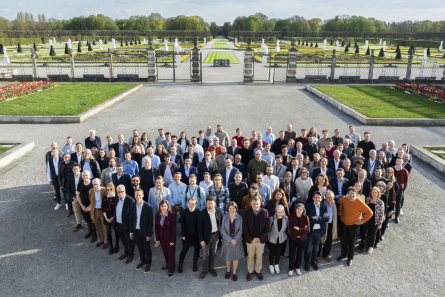
As part of the theme week “Multiple Crises – Strained Resources” organized by the Volkswagen Foundation, iaw Director Timur Ergen, together with Helen Callaghan (University of Mainz) and Bob Hancké (LSE), hosted a symposium on Europe’s industrial policy options in the context of digital, green, and geoeconomic transformation.

Over the course of three days, more than 50 researchers from political economy, economic history, economic sociology, and related disciplines discussed how European cooperation can open up new perspectives for addressing Europe’s most pressing economic policy challenges.

Keynote lectures were delivered by Cornelia Woll (Hertie School), Brooke Harrington (Dartmouth College), David Soskice (LSE), Maive Rute (European Commission), and Kathleen McNamara (Georgetown University).

Photo: Charlotte Licht
We make transition!

We make transition! partner University of Bremen organised a two-day study visit to Bremen especially for those partners and stakeholders that had organised transition arena on the topic of sustainable food: Vidzeme, Trondheim and Hämeenkyrö. The event included visits to organic food distribution center "Naturkost Kontor", organic farm "Kaemena" and visits to two school kitchens.


Some of the We make transition! arenas focused on the topic of sustainable local food and especially promotion of organic food in public procurement and school catering.

The Bremen study visit included a visit to Naturkost Kontor, a distribution center specialising in organic food products gave insights on how sustainable supply chains are organised, as well as the challenges and opportunities of distributing organic food to schools, kindergartens, and other institutions. The exchange with Joern Rathjen highlighted practical aspects of procurement, logistics, and partnerships within Bremen’s sustainable food system.

A true highlight was the visit to Hof Kaemena, a family-run organic farm located near Bremen. The farm is well known for its commitment to ecological agriculture and innovative approaches such as its popular “cow-sharing” initiative. During the visit, participants gained insights into organic milk production, animal and biodiversity friendly farming practices, and the role of local farms in community-based food systems. Kaemena Farm is very popular place for families to visit during summers. The ice cream that is produced from the organic milk was delicious!

We also visited two school kitchens Andernacher Straße and Oberschule Kurt-Schumacher-Allee. Participants learned that 90% of the ingredients used in these schools are organic, and that one key success factor on switching to organic food has been rethinking the entire menu.

“We gained practical insights into how a Bioregion could operate in practice and how collaboration can be successfully built across different actors and levels. Sustainability transformations need those changemakers and individuals that work persistently according to their values”
    – Lienīte Priedāja-Klepere, Vidzeme Planning region

Overall, study visit to Bremen gave inspiration and understanding of the key role of organic and healthy food in developing sustainable food systems.

 Link: Study visit to Bremen


Contact:
Dr. rer. pol. Tina Schneider
Domshof 26
28195 Bremen
Phone: +49 421 218-61701
E-Mail: tina.schneider@uni-bremen.de

01.09.2025

New community engagement portal for Bremen goes live: The Mitmachkompass is here!

How and where can Bremen residents actively participate in political and social decision-making? What participatory formats are already available—and how can they be used? Answers are now provided by the Bremen Participation Guide (Mitmachkompass Bremen), which is available online starting today: https://mitmachkompass.bremen.edu

Out now: Part of the book series "Global Dynamics of Social Policy"

The volume is edited by the Principle Investigators Ulrich Mückenberger (labour and social security law and political science) and Irene Dingeldey (political science and labour market sociology) and the Postdoc Heiner Fechner (labour law, law and development and human rights) of the project "Worlds of Labour" (WoL), based on the work of the editors and of former and present project members, namely Marina Carlino, Jean-Yves Gerlitz, Jenny Hahs and Andrea Schäfer.

This open access book "Constructing Worlds of Labour" aims to break new ground in presenting results on different types of labour standards around the world as regulatory social policy. The particular topic is to make visible that, and to explain why, employment law world-wide has not only a protective role, but also a segmenting role – creating status, gender- and/or race-based hierarchical social differentiation. We conceptualised this role of law as legal segmentation and identified various historical, and power-related reasons for legal segmentation. We also identified how segmenting employment law interacts with segmentative implications of other (current and/or historical) legal institutions – such as social law, family law, tax law, but also slavery, gender-, race- and ethnicity-based legislation. As explanations not only path dependent institutional development, but also colonial influences, international organisations and epistemic communities including postcolonial thought are considered and made subject of in-depth investigations. The outcomes of research are vividly discussed in order to submit propositions on how to overcome the identified situation in the different worlds of labour. Hence, not only applying a global perspective, but also treading new paths in an interdisciplinary way – both theoretically/normatively and empirically –, makes this book outstanding.

The volume also intends to encourage a discussion of the concept, the methodology and the results by members of the scientific community. Chapters of Tzehainesh Teklè and of Simon Deakin discuss the use of leximetrics. Ludger Pries and Kerry Rittich also widen the scope of analysis. The former proposes a sociological view on the international arenas and actors of labour regulation. The latter lances a critical perspective on legal segmentation executed by legal factors beyond labour markets, beyond labour law and beyond the international institutions traditionally dealing with labour.


Contact:
Prof. Dr. Irene Dingeldey
CRC 1342: Global Dynamics of Social Policy, Institute Labour and Economy
Wiener Straße 9 / Ecke Celsiusstraße
28359 Bremen
Phone: +49 421 218-61710
E-Mail: dingeldey@uni-bremen.de

Dr. Heiner Fechner
CRC 1342: Global Dynamics of Social Policy
Mary-Somerville-Straße 7
28359 Bremen
Phone: +49-421-218-57070
E-Mail: hfechner@uni-bremen.de

Prof. Dr. Ulrich Mückenberger
CRC 1342: Global Dynamics of Social Policy, Faculty of Law
Universitätsallee, GW1
28359 Bremen
Phone: +49 421 218-66218
E-Mail: mueckenb@uni-bremen.de

Work-Net Logo
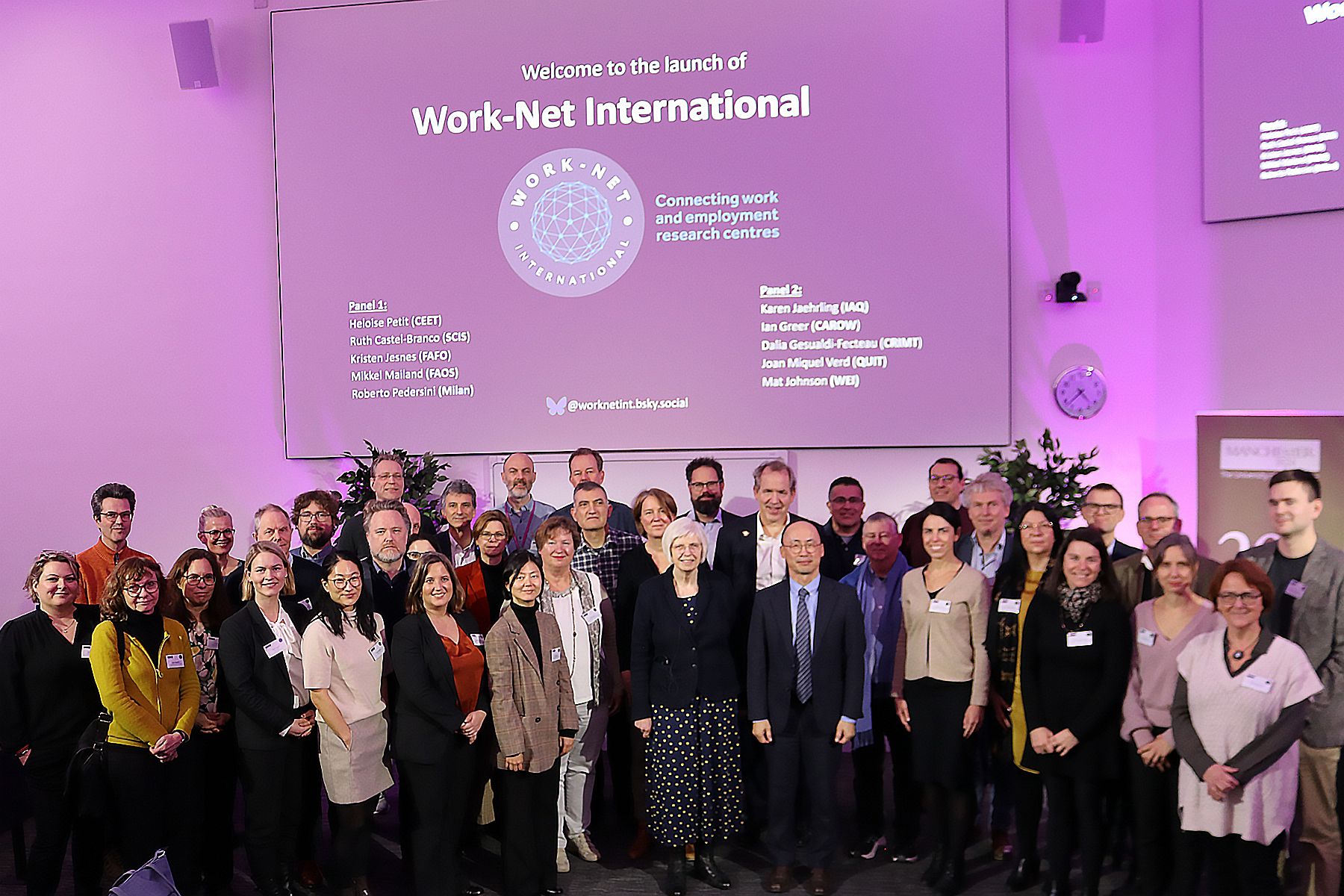
A special event celebrating the launch of Work-Net International, a groundbreaking global network dedicated to advancing research on work and employment, took place on Tuesday, 21 January 2025.

The event has been part of the Work Equalities Institute's two-day Sixth Fairness at Work conference, hosted by the Alliance Manchester Business School (AMBS) at The University of Manchester.

The launch event has welcome 26 of Work-Net International's 31 founding members to The University of Manchester - among them also the director of the Institute of Labour and Economy, Prof. Dr. Irene Dingeldey. Work-net is  bringing together scholars, policymakers, and practitioners to explore the network's potential to influence international policy and academic discourse on critical issues related to work and employment.


https://www.wei.manchester.ac.uk/research/networks/work-net-international/


WNI full network-2025.jpg (324 KB)

Sustainability vision for 2035 of the project: "We make transition!"

We-make-transition.pdf (2.39 MB)

Geopolitical risks : What changes for Germany and Europe?

ED: Thomas Gehrig (University of Vienna), Lukas Menkhoff (HU Berlin), Doris Neuberger (University of Rostock), Dorothea Schäfer (iaw University of Bremen)

The crises of the 21st century have exposed significant weaknesses in globalized free trade. Both the Corona pandemic and the economic reactions to Russia's invasion of the Ukraine have shown the extreme dependence of Western industrial nations on a few large producers with significant market power. On the one hand, this affects high-tech goods based on computer chips, solar cells, wind turbines and pharmaceutical products, but on the other hand also raw materials, energy and bulk goods such as health and safety masks. In many places, blindly trusting in the functioning of the market, security of supply in the event of a crisis was carelessly overlooked.

Against this background, the question arises about the specific risks to the security of supply chains and the reasons why these are insufficiently insured in a globalized world. Who is affected and how will existing inequalities between population groups or regions be increased? What political conclusions can be drawn from the findings, and are deglobalization or friend-shoring indeed part of the correct answer?

How do the capital markets react to geopolitical risks – do they fulfill an insurance function or do they increase instabilities? What changes in the markets for international capital movements due to the new geopolitical risks are necessary? Are private, capital market-based risk sharing instruments more efficient than public ones? To what extent should the state intervene through trade restrictions, subsidies or transfers?

This issue addresses a variety of individual topics relating to the general topic of “geopolitical risks”. Of particular interest is the handling of geopolitical risks that arise in connection with: 

  • Supply chains in the shadow of uncertainty
    • renewable energies: solar panels, wind turbines
    • Chip production
    • Pharmaceutical industry
    • Resources: rare earths and other raw materials
  • Production networks and spillovers
  • Geopolitical risks
    • Political risks and sanctions
    • Trade risks and subsidy competition
      • Trade with autocratic countries
      • Trade without a legal system
      • Multi-sourcing
    • Geopolitical risks and financial markets
      • Foreign Direct Investment (FDI)
      • Private financial flows: Are there new risk premiums?
      • Is the synchronization of returns decreasing again?
      • Role of development financing
      • Remittances/Migration: Changes caused by geopolitical tensions
      • Role of foreign exchange market interventions
      • Government debt, especially in emerging countries, Africa
      • Role of the IMF (generally international financial institutions)
      • Is system stability influenced?
      • Payment transactions, retention of Russian funds,
      • Importance of competing institutions (e.g. BRICs), future of the Belt and Road Initiative


Authors who would like to submit a contribution (in German or English language) should send a short outline of the planned contribution (about 1/3-1/2 page) as soon as possible, but no later than June 15, 2024 to the Editors Thomas Gehrig (thomas.gehrig@univie.ac.at), Lukas Menkhoff (lmenkhoff@diw.de), Doris Neuberger (doris.neuberger@uni-rostock.de) and Dorothea Schäfer (vaw@uni-bremen.de). Feedback will be given within 10 days. The finished contributions, which should not exceed 40,000 characters in length, must be submitted in the first version by November 1, 2024. This is followed by a one- or two-stage peer review and revision process. Please note that manuscripts can only be submitted in Word format. We require images as separate files and in reproducible quality. The “Geopolitical Risks” issue of the Quarterly Journal of Labour and Economic Research will be published in May 2025.

Link Duncker & Humblot

We make transition! partners and change agents from six Baltic Sea region countries met in Gdynia, Poland for two intensive days (14-15 February 2024). The meeting was full of sharing and inspiring!

Joint vision and recommendations

More than 50 meeting participants worked in small groups with tasks such as:
– imagine a life of a person in the future that is sustainable
– what the local authorities should do in order to reach a future where civil society actors are empowered to enhance ecological and social sustainability?

The results of group works are used to elaborate the “joint vision of sustainable life in the Baltic Sea region and recommendations” to be published later in spring.

Kick-off in Helsinki
First meeting of the project participants in the EU Interreg project "We make transition!

project homepage


Contact:
Dr. rer. pol. Tina Schneider
Domshof 26
28195 Bremen
Phone: +49 421 218-61701
E-Mail: tina.schneider@uni-bremen.de

Issue No. 32 of iaw Schriftenreihe

This paper examines how the collective bargaining parties of the German metal and electrical industry, Gesamtmetall and IG Metall, portrayed the Corona crisis in the public sphere. The empirical basis consists of press releases, guest contributions by the chairpersons and press interviews. The framing perspective adopted by this study promises to shed light on how the collective bargaining parties assess the social partnership's ability to act and what priorities they set. Social partnership is also coming under increasing pressure in the core areas of the German economic model. This is also reflected in our analysis: While at first glance there is a coalition of interests in the description of the crisis and the call for state aid to support the economy and safeguard employees, this is characterized by a strong imbalance. It is not just a matter of purely strategic cooperation on specific issues.
The employer-side also insists on wage restraint and leaves unanswered union calls for a more farreaching joint assumption of responsibility. Particularly against the backdrop of further effects of the pandemic on the labor market, this weakens the unions' bargaining power and puts further pressure on the institutional pattern of social partnership.

Hopp, Marvin; Kiess, Johannes; Menz, Wolfgang; Seeliger, Martin, (2022): „Social Partnership Revival“ The Framing of the Covid-19-Crisis in the German metal sector, Erschienen in: Schriftenreihe Institut Arbeit und Wirtschaft Bd. 32 // Download PDF